General Description
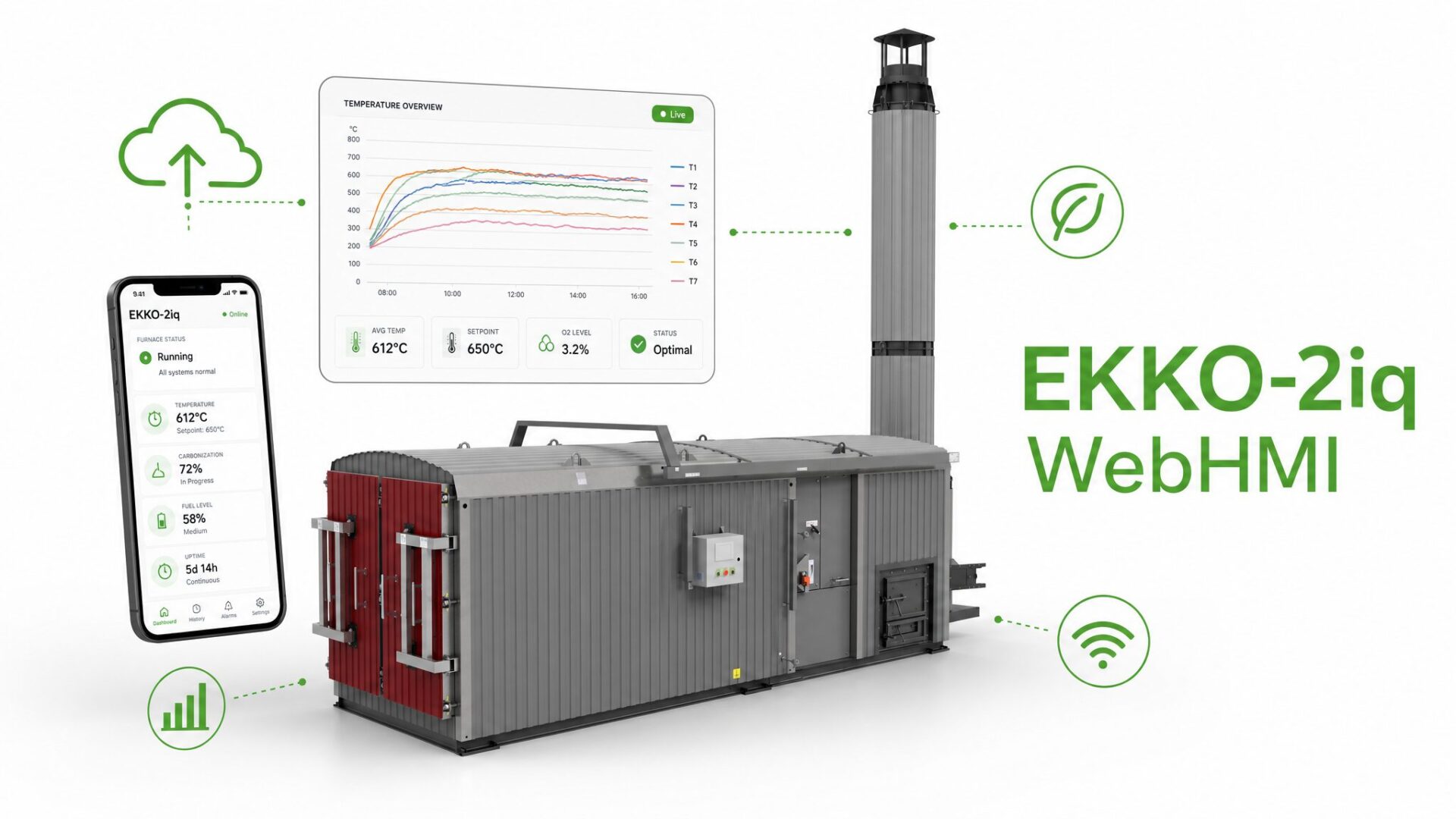
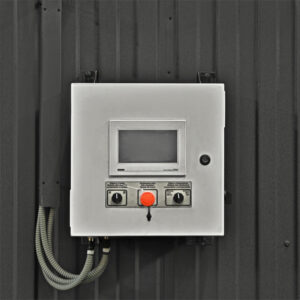
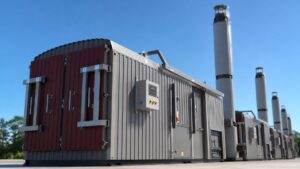
To improve the efficiency and operational transparency of a carbonization complex comprising up to 22 individual EKKO-2iq Pyrolysis units, a remote monitoring system based on WebHMI Level 2 is implemented, including the automated control system (ACS) of each EKKO-2iq Pyrolysis unit using standard PC-based solutions.
The purpose of the dispatching system is to provide the manager with centralized, continuous information on the status of all Pyrolysis units, operator actions, and any operational deviations.
Description of the remote monitoring system for the EKKO-2iq pyrolysis unit complex
Find out the price
System Architecture
1. Each EKKO-2iq Pyrolysis unit is equipped with its own Mitsubishi PLC-based ACS and a WebHMI online control and monitoring system;
2. Each Pyrolysis unit has a separate mobile client and display on the WebHMI server;
3. All Pyrolysis units are integrated into WebHMI Level 2 with a shared display center on the Complex Operator panel and the option of display duplication;
4. Real-time data exchange is possible via the Internet using WebHMI;
5. The manager is granted access to the central control panel, which receives notifications on the “current situation at each Pyrolysis unit” including “process deviation notifications” and to the “mobile client” through which the Operator can make adjustments to the system operation and carry out a detailed analysis of “the operation of a specific Pyrolysis unit.”
Dispatching System Philosophy
1. The ACS of each Pyrolysis unit is the source of commands (a conditional stimulus)
2. The Operator (personnel) responds to commands from the ACS by performing the actions required to ensure the production process;
3. Through WebHMI, the Supervisor monitors whether the required operations have been performed by personnel and receives notifications “on the operation of the system of each individual Pyrolysis unit” (primarily monitoring personnel actions);
4. If a “command” is not performed by the Operator (personnel), a signal is sent to the Supervisor to notify them that the required actions have not been performed by the Operator (personnel);

Role of the Operator (Personnel) in the System
The Operator (personnel) does not interfere with the control logic of each individual Pyrolysis unit. If adjustments to ACS operation are required, the Operator notifies the Supervisor that adjustments have been made to ACS operation.
Required actions of the Operator (personnel):
1. Chamber reloading (rail cart replacement): confirmed by pressing the “Reloading completed” button.
2. Opening and closing the gas valve on the pyrolysis chamber upon receipt of a notification;
3. Closing the ash pan and firebox door (limit switches) under pyrolysis gas generation conditions;
4. Adding fuel to the Pyrolysis unit upon receipt of the “Add fuel” notification;
5. Responding to process deviation signals: thermocouple failures, drive malfunctions, overheating, etc.
Role of the Supervisor in the System
The Supervisor does not interfere with the control logic of each individual Pyrolysis unit unless the situation requires it. The ACS of each Pyrolysis unit includes “countdown timers,” “process progress notifications,” and “process deviation notifications.” The Supervisor receives notifications on the central control panel as well as SMS messages on a mobile phone: “upon expiry of the countdown timer,” “process progress notifications,” and “process deviation notifications.”
Description
Read more
Monitoring and Control System
Monitoring and Control System
1. Monitoring and control of each individual Pyrolysis unit by the Operator.
The Operator receives informational messages from the ACS on the display of each Pyrolysis unit, including audible notifications and pop-up windows indicating the need to perform actions, and acts in accordance with the Operator’s Instructions.
2. Monitoring and control of each individual Pyrolysis unit by the Supervisor.
2.1. Timing of Operator actions.
The ACS of each Pyrolysis unit includes countdown timers with the option to set the timing value (Supervisor setting). Upon expiry of the timer, the Supervisor receives an ACS notification with the “notification name” and Pyrolysis unit number, for the purpose of monitoring actions and identifying reasons for their non-performance by the Operator:
A. Chamber reloading (rail cart replacement): confirmed by pressing the “Reloading completed” button.
B. Opening and closing the gas valve on the pyrolysis chamber upon receipt of a notification, if gas-valve control is not provided by the ACS.
C. Closing the ash pan and firebox assembly door under pyrolysis gas generation conditions.
D. Adding fuel upon receipt of the “Add fuel” notification.
2.2. Process progress notifications.
The ACS of each Pyrolysis unit includes notifications on the progress of feedstock carbonization, specifically on changes in the operating modes of the Pyrolysis unit. The Supervisor receives a notification from the ACS whenever the current operating mode of the Pyrolysis unit changes, displaying the current temperature parameters and Pyrolysis unit number:
A. DRYING — display of thermocouple readings.
B. PYROLYSIS START — display of thermocouple readings.
C. PYROLYSIS END — display of thermocouple readings.
D. CHARCOAL READY — display of thermocouple readings.
E. RELOADING — display of thermocouple readings.
2.3. Process deviation notifications.
The ACS of each Pyrolysis unit includes informational “process deviation” notifications. In real time, the Supervisor receives a notification with the “notification name” and Pyrolysis unit number, namely:
A. Loss of communication with the temperature sensor.
B. Exceeding the permissible temperature at the temperature sensor.
C. Failure of the pyrolysis chamber damper drive A or B.
D. Failure of the secondary thermal oxidizer damper drive.
E. Failure of the pre-drying induced-draft fan.
F. Failure of the pre-drying mixer air damper.
Read more