
Feedstock Preparation and Carbonization Concept for Production of Metallurgical Charcoal for FeSi
1. Mechanical Strength of Metallurgical Charcoal and the Importance of Minimizing Fines
For FeSi production, the size of the charcoal fraction is important; however, the key technical parameter is the mechanical strength of the charcoal and its ability to withstand transportation, storage, handling, dosing, and charging into the electric arc furnace without excessive degradation and formation of fines.
The presence of excessive fine charcoal fraction is undesirable not only because of material losses, but also because it can negatively affect furnace operation.
Inside a submerged electric arc furnace, carbonaceous reducing agents perform two critical functions:
- supplying carbon for reduction reactions;
- maintaining sufficient gas permeability of the burden.
When excessive fines are present, the permeability of the burden decreases. This can lead to:
- deterioration of gas circulation through the burden;
- increased pressure drop;
- uneven gas distribution;
- unstable reaction zones;
- reduced reduction efficiency;
- less stable furnace operation.
Fine charcoal particles also have a significantly larger specific surface area than larger particles. As a result, they react faster and may be consumed before reaching the deeper reaction zones where carbon is required.
In addition, dust generation during transportation, storage, loading, and charging causes material losses and operational challenges.
For these reasons, FeSi producers are generally interested not only in obtaining a target charcoal fraction but also in minimizing the generation of fines throughout the entire logistics chain.
In practice, when charcoal has low mechanical strength, consumers often attempt to compensate by using larger charcoal fractions. The logic is simple: if the charcoal partially breaks during transportation and handling, a larger initial particle has a greater chance of remaining within the required working fraction before entering the furnace.
However, this approach addresses the consequence rather than the root cause.
Mechanisms of Charcoal Mechanical Strength Reduction
The reduction of charcoal mechanical strength is caused by several physical and chemical mechanisms acting simultaneously during drying and carbonization. These include:
- internal thermal stresses caused by temperature gradients within the particle during heating;
- steam pressure generated inside the biomass structure when residual moisture is rapidly vaporized;
- cracking of the cellular structure due to differential thermal expansion and contraction;
- non-uniform shrinkage during drying and pyrolysis, leading to internal stress concentrations;
- local oxidation caused by oxygen ingress into the carbonization zone;
- gasification reactions, including the water-gas reaction H₂O + C → CO + H₂, which partially consumes carbon, increases porosity, and weakens the carbon skeleton.
The combined effect of these mechanisms can increase porosity, create microcracks, weaken the carbon skeleton, and promote fines generation during handling and transport. Insufficient drying of the biomass before carbonization is one of the primary contributing factors, as it amplifies the intensity of steam pressure, gasification reactions, and non-uniform shrinkage simultaneously.
This problem is particularly common in traditional or artisanal charcoal production systems. In such systems it is practically impossible to ensure:
- uniform drying of the biomass;
- consistent moisture content throughout the material;
- controlled heating conditions;
- uniform carbonization;
- minimal contact between water vapor and hot charcoal.
Consequently, the final product often exhibits internal cracks, heterogeneous properties, reduced density, and poor mechanical strength.
2. Technical Challenges Associated with Feedstock Larger Than 60 mm
The requirement for large charcoal fractions inevitably leads to consideration of larger wood feedstock.
However, feedstock larger than 60 mm creates several engineering challenges. First, oversized biomass complicates logistics and material handling.
Second, it creates operational challenges for standard industrial equipment, including:
- screw conveyors;
- bucket elevators;
- rotary airlocks;
- storage hoppers;
- drum dryers;
- automatic feeding systems;
- discharge systems.
Third, large particles affect heat transfer and material movement inside the reactor.
For BIO-Carbon industrial technology concept, the theoretical upper feedstock size limit is approximately 80 mm. However, for reliable industrial operation, the practical recommended maximum size is approximately 60 mm, considering the minimum feedstock channel cross-section of approximately 180 mm.
In practice, biomass larger than 60 mm is commonly processed in batch-type furnaces. Continuous moving-bed shaft technologies can theoretically process larger material sizes; however, such systems typically require direct contact between the feedstock and the heat carrier.
This generally results in:
- higher CAPEX;
- more complex equipment;
- unresolved handling challenges
- potentially lower charcoal yield.
3. Importance of Feedstock Size Reduction Before Drying
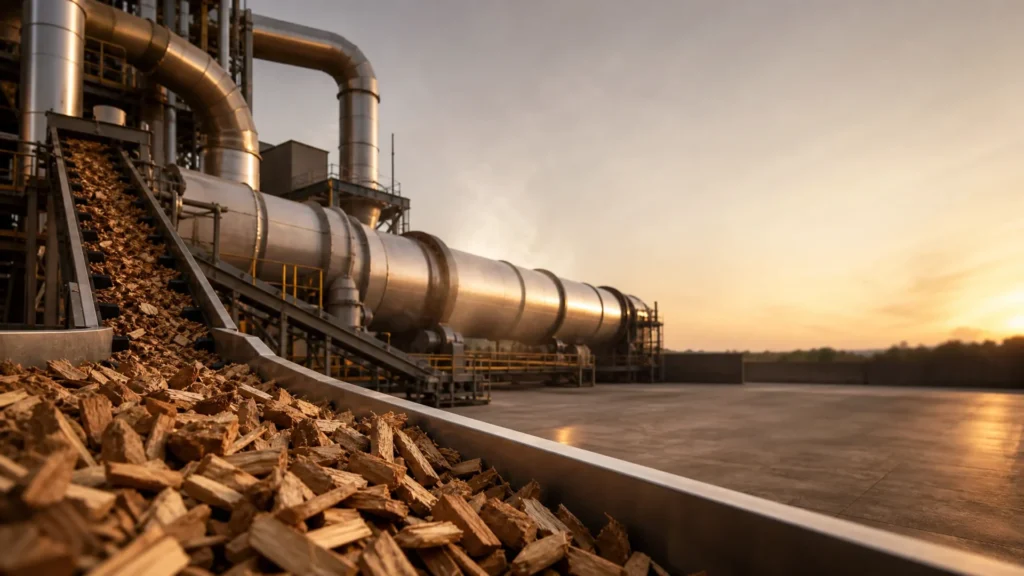
The proposed solution is not simply to increase the charcoal particle size but to improve the physical quality and mechanical strength of the charcoal itself.
For this reason, wood should be crushed before drying and carbonization.
The proposed feedstock fraction is: 25–60 mm
This fraction is technically advantageous because large wood pieces are extremely difficult to dry uniformly. Wood contains a natural capillary and fiber structure designed to transport water and gases during tree growth. As the diameter of the wood increases, the distance moisture must travel from the center of the particle to the surface increases significantly.
As a result:
- drying time increases substantially;
- moisture distribution becomes non-uniform;
- the surface may become dry while the core remains wet;
- steam pressure develops during pyrolysis;
- internal cracking occurs;
- charcoal mechanical strength decreases.
By reducing the wood size to 25–60 mm, the moisture migration path becomes significantly shorter, enabling more uniform drying before carbonization.
Biomass Shrinkage During Carbonization
An important engineering factor that must be considered when selecting feedstock size is dimensional shrinkage of biomass during drying and carbonization. Based on published literature and industrial observations, linear shrinkage of woody biomass during carbonization is typically in the range of 20–35%, and may approach 40% depending on species, initial moisture content, and final carbonization temperature. Volumetric shrinkage is substantially higher and may exceed 50–60%.
Consequently, feedstock sizing must account for expected shrinkage when targeting the final charcoal particle size distribution required by FeSi producers. For example, feedstock in the 25–60 mm range may yield charcoal in the approximate range of 15–45 mm after carbonization, depending on process conditions and wood species.
Based on operational characteristics of industrial shredding and chipping equipment processing woody biomass, the expected particle size distribution after crushing is preliminary estimated as follows:
- 25–60 mm: approximately 85%
- <25 mm: approximately 12%
- >60 mm: approximately 3%
Note: This distribution is a preliminary engineering estimate derived from operational data of industrial shredder and chipper equipment. The actual distribution must be confirmed through granulometric testing of the selected feedstock and specific equipment configuration.
The fine fraction (<25 mm) can be removed through screening and separation before drying and carbonization. This approach provides a homogeneous feedstock suitable for industrial processing while maintaining compatibility with standard material handling equipment and rotary drum dryers.
Therefore, the proposed 25–60 mm feedstock fraction should be considered an engineering compromise between drying efficiency, charcoal mechanical strength, charcoal yield, equipment reliability, and overall process stability. This fraction allows effective moisture removal while remaining compatible with industrial conveying, drying, and continuous carbonization systems.
4. Drum Drying of the 25–60 mm Fraction
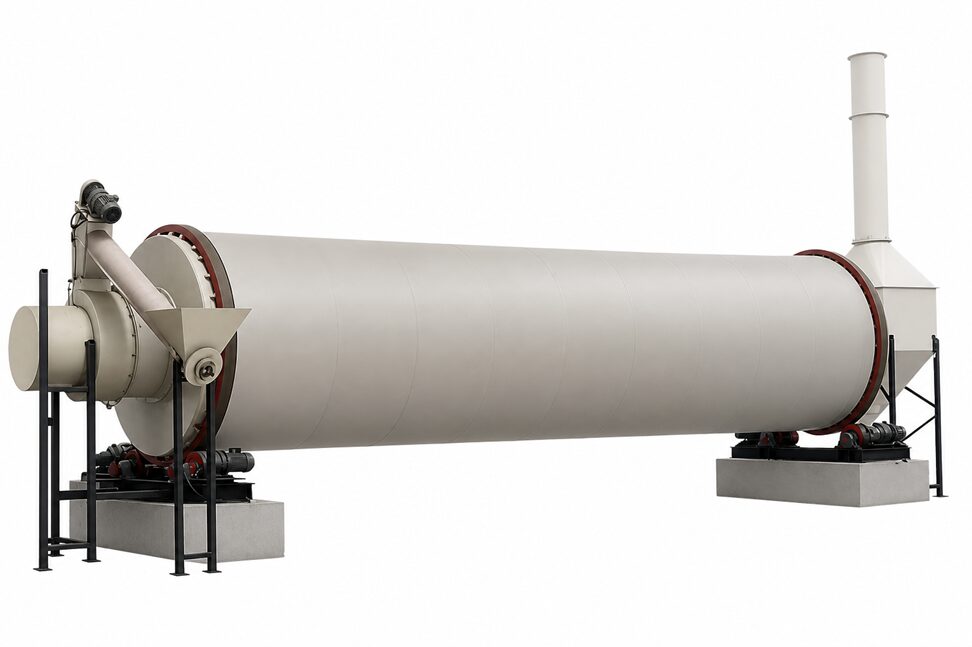
The prepared wood chips are dried using a rotary drum dryer.
The target moisture content after drying is: 10–12%
This moisture range is critical for obtaining mechanically strong charcoal and maintaining stable carbonization conditions.
According to preliminary industrial estimates, for wood chips in the 25–60 mm range, the drying capacity is approximately 0.7–0.8 t/h under conditions normally used for a nominal 1 t/h drum drying system.
The reduction in dryer productivity of approximately 20–25% is caused by the slower heat and moisture transfer inside larger particles.
However, this productivity loss is compensated by improved feedstock quality and superior charcoal mechanical strength.
5. Carbonization Using “BIO-Carbon” System
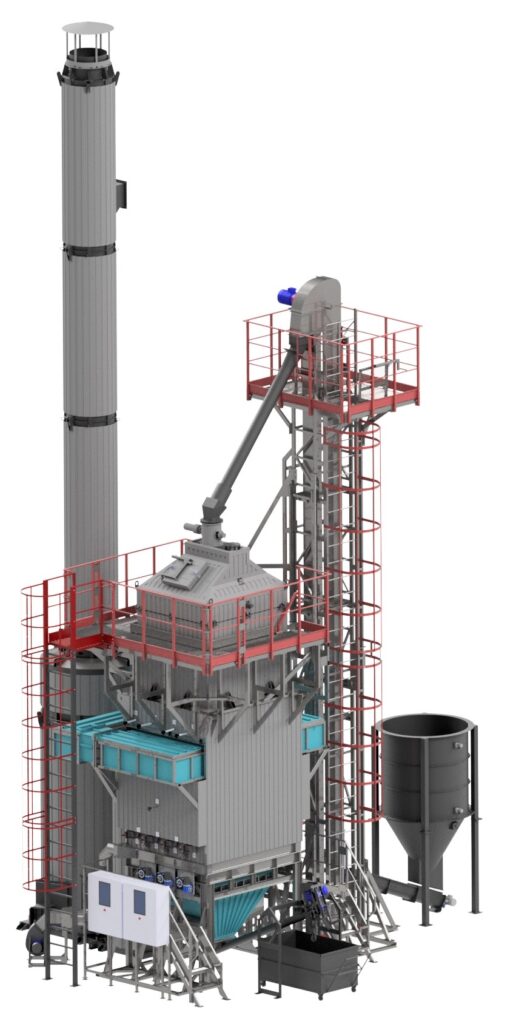
After drying, the prepared biomass is processed in the BIO-Carbon continuous dry carbonization system.
Key process principles include:
- continuous moving-bed operation;
- indirect heating of biomass;
- no oxygen access into the carbonization zone;
- controlled slow pyrolysis;
- stable temperature profile;
- controlled product discharge.
Unlike direct-heating systems, BIO-Carbon prevents direct contact between the biomass and combustion gases inside the carbonization channel.
This significantly reduces:
- local oxidation;
- uncontrolled carbon consumption;
- overheating;
- structural damage to charcoal.
The controlled slow pyrolysis process allows the carbon structure to develop uniformly throughout the particle. Combined with low feedstock moisture content, this minimizes internal steam pressure and significantly reduces cracking during carbonization.
The result is charcoal with improved mechanical strength and reduced fines generation.
Preliminary Target Quality Parameters for Metallurgical Charcoal (FeSi Application)
The following engineering targets are used as preliminary design references for the BIO-Carbon-3 production concept, subject to confirmation through industrial-scale testing:
| Parameter | Target Value |
| Fixed Carbon (Cfix) | > 82% |
| Ash Content | < 3% |
| Volatile Matter (VM) | < 15% |
| Moisture Content | < 8% |
| Fines < 10 mm | < 5–10% |
| Main Product Fraction | 20–40 mm |
Benchmark: Fossil Reductants in FeSi Production
It is important to note that FeSi production commonly utilizes fossil reductants — such as metallurgical coal and coke — typically in the fraction range of 20–40 mm, often in combination with wood chips. This established industrial practice provides a practical engineering benchmark: the target for bio-based charcoal should not be to maximize lump size, but to produce charcoal with sufficient mechanical strength to maintain a working fraction comparable to the fossil reductants already used in industrial furnaces. A stable charcoal fraction in the 20–60 mm range, with low fines generation throughout the logistics chain, is therefore a technically justified and commercially relevant target.
6. Cooling and Product Handling
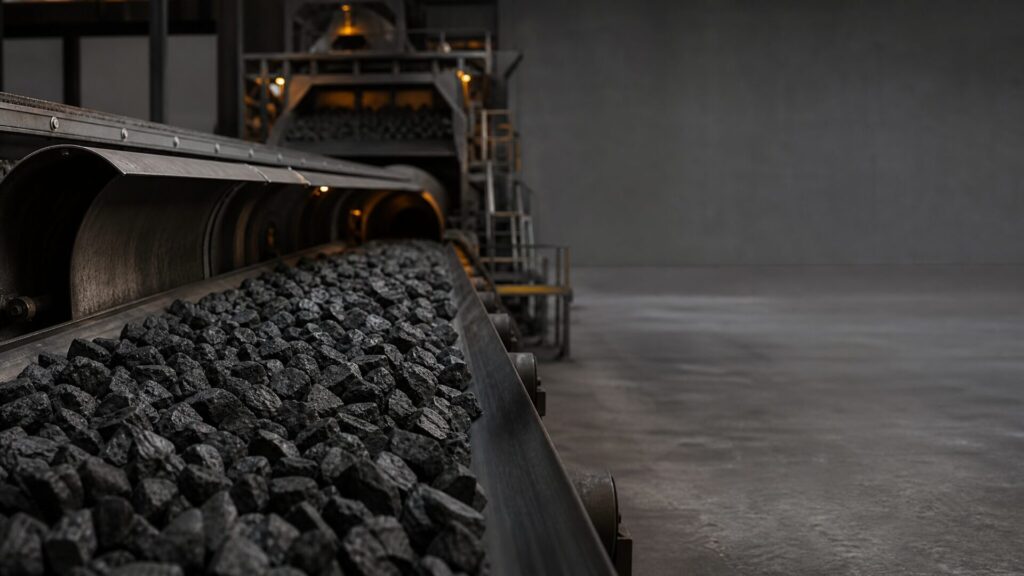
Following carbonization, the charcoal is cooled under controlled conditions.
Controlled cooling is essential because hot charcoal remains both mechanically sensitive and chemically active.
Improper cooling can lead to:
- oxidation;
- cracking;
- additional carbon losses;
- generation of fines.
After cooling, the product is screened and prepared for metallurgical use.
The objective is not only to produce the target fraction but also to preserve that fraction throughout:
- discharge;
- cooling;
- storage;
- loading;
- transportation;
- unloading;
- furnace charging.
7. Technical Conclusion
The proposed technological concept is based on eliminating the physical causes of charcoal degradation rather than compensating for poor charcoal quality through larger particle size.
The engineering logic is straightforward:
- Large charcoal fractions are often required because weak charcoal breaks during transportation and handling.
- Weak charcoal is often associated with multiple simultaneous mechanisms: internal thermal stresses, steam pressure, cracking of the cellular structure, non-uniform shrinkage, local oxidation, and gasification reactions including H₂O + C → CO + H₂.
- Insufficient drying of biomass before carbonization amplifies the intensity of all these degradation mechanisms simultaneously.
- Large wood pieces are difficult to dry because moisture must migrate through the internal capillary and fiber structure of the wood.
- Crushing wood to 25–60 mm significantly improves drying efficiency and moisture uniformity.
- Biomass shrinkage during carbonization is typically 20–35% (linear), and may approach 40% depending on species and process conditions. Feedstock sizing must account for this shrinkage when targeting the final charcoal fraction.
- Rotary drum drying to 10–12% moisture minimizes steam generation and reduces the intensity of gasification reactions during carbonization.
- BIO-Carbon dry pyrolysis system utilizes indirect heating and prevents oxygen from entering the carbonization zone, ensuring controlled slow pyrolysis.
- Controlled pyrolysis minimizes cracking, structural damage, uncontrolled oxidation, and fines formation.
- Controlled cooling preserves charcoal integrity throughout subsequent handling and logistics.
- FeSi production already uses fossil reductants in the 20–40 mm fraction as a standard practice. This provides a practical benchmark: bio-based charcoal in the 20–60 mm range with high mechanical strength and low fines generation is a technically justified and commercially relevant target.
As a result, the proposed process chain:
Crushing → Screening → Drum Drying → Carbonization by “BIO-Carbon” system → Controlled Cooling → Final Screening
addresses the root causes of charcoal degradation and creates the conditions necessary to produce metallurgical charcoal with improved mechanical strength, reduced fines generation, and greater suitability for FeSi production.
The objective is not simply to manufacture larger charcoal pieces, but to produce stronger charcoal that maintains its required working fraction from the carbonization plant to the electric arc furnace.
Nevertheless, the final target charcoal fraction should ultimately be validated and approved by the end-user and furnace operator through industrial-scale testing. Such testing should confirm not only the acceptable particle size distribution but also the behavior of the charcoal inside the FeSi furnace, including burden permeability, fines generation, reduction performance, and overall furnace stability.
