In charcoal and biochar production, downtime is often treated as inevitable. Batch systems require cooling, unloading, reheating, and operator intervention between cycles. Each stop reduces effective output, increases labor costs, and creates variability in product quality.
Continuous production changes the economic model.
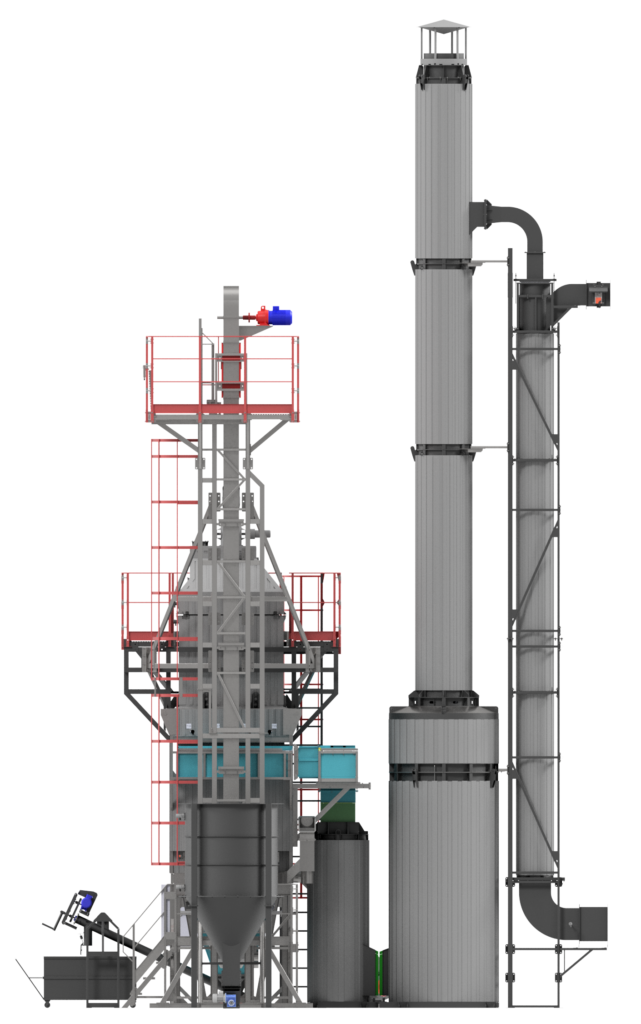
BIO-CARBON, developed by GREENPOWER, operates 24/7 without technological stops. The carbonization process is continuous and highly automated — from raw material feeding to finished charcoal unloading. There is no need to interrupt production for cycle resets, which means stable throughput and predictable daily volumes.
The economic impact is measurable.
First, effective capacity increases. When production runs continuously, the equipment delivers closer to its theoretical output instead of losing hours between cycles. This improves return on investment (ROI) without increasing the facility’s footprint.
Second, labor costs decrease. Automated control reduces the need for constant operator adjustments. Process parameters are managed by temperature-driven logic, not manual decisions, minimizing human error and variability.
Third, energy efficiency improves. Continuous operation stabilizes the thermal balance inside the furnace. Pyrolysis gases are fully combusted in afterburners, generating usable heat that can be redirected for drying raw materials or charcoal briquettes, or produce heat energy for other consumers. This lowers external energy demand and reduces operating costs.
Finally, product quality becomes repeatable. Stable residence time and controlled carbonization allow for consistent fixed carbon (Cfix) levels and minimized ash content.
For industrial applications — particularly metallurgical carbon for ferroalloys and steelmaking, as well as reductants in silicon production — oxidative instability is technically unacceptable. Even minimal oxygen ingress during carbonization alters the carbon matrix, reduces fixed carbon (Cfix), increases ash content, and changes reactivity parameters. In silicon production and ferroalloy smelting, such deviations directly impact reduction kinetics, electrical energy consumption, and overall furnace efficiency. Stable, high-purity carbon with predictable structure can only be achieved under strictly controlled, oxygen-free thermal conditions.
In modern industrial production, profitability is not only about installed capacity. It is about effective operating hours and stable repeatable high level quality product production.
24/7 without stops is not just a technical feature. It is an economic advantage.